Micro-Credentials Reshaping U.S. Professional Development by 2026

Micro-credentials are rapidly transforming U.S. professional development by offering focused, verifiable skill-based learning, enabling workers to adapt swiftly to industry changes and enhance career mobility by 2026.
The landscape of lifelong learning and career advancement in the United States is undergoing a profound transformation, spearheaded by the rise of micro-credentials: how they’re reshaping U.S. professional development by 2026. These bite-sized, verifiable qualifications are swiftly becoming a cornerstone for individuals and organizations alike, promising a more agile and responsive approach to skill acquisition in a rapidly evolving job market. How are these focused learning pathways redefining what it means to be professionally competent and competitive?
The evolving landscape of professional development
The traditional model of professional development, often characterized by lengthy degree programs or generic workshops, is increasingly struggling to keep pace with the swift technological advancements and shifting demands of the modern workforce. Industries are transforming at an unprecedented rate, creating skill gaps that conventional education systems find difficult to bridge. This dynamic environment necessitates a more flexible and targeted approach to learning, one that micro-credentials are uniquely positioned to provide.
The U.S. economy, in particular, is witnessing a surge in demand for specialized skills that often fall outside the scope of broad academic degrees. Employers are no longer solely looking for degrees but for demonstrable competencies that can be immediately applied to specific roles and projects. This focus on practical application is driving the adoption of alternative credentialing methods.
The shift from degrees to skills
For decades, a bachelor’s or master’s degree was the gold standard for professional entry and advancement. While degrees still hold significant value, the emphasis is now shifting towards a skills-based economy. Companies prioritize candidates who possess specific, verifiable skills, regardless of how or where those skills were acquired. This paradigm shift benefits both employers, who can more precisely fill talent gaps, and employees, who can target their learning efforts more effectively.
- Employer needs: A direct response to specific skill shortages.
- Employee empowerment: Opportunities for targeted upskilling and reskilling.
- Faster adaptation: Quicker response to market changes and technological innovations.
- Cost-effectiveness: Often more affordable than traditional degree programs.
This fundamental re-evaluation of what constitutes valuable professional qualifications is setting the stage for micro-credentials to become a dominant force in U.S. professional development. Their ability to deliver precise, in-demand skills in a condensed timeframe makes them an attractive option for a workforce constantly striving to remain relevant.
Defining micro-credentials: What are they?
Micro-credentials are essentially certifications of specific knowledge, skills, or competencies acquired through short, focused learning experiences. Unlike traditional degrees that cover a broad curriculum over several years, micro-credentials zoom in on particular areas, often taking weeks or months to complete. They are typically awarded by educational institutions, professional organizations, or even employers, and are increasingly recognized as legitimate proof of expertise.
These credentials can range from digital badges for mastering a specific software tool to certificates for completing a specialized project management module. Their value lies in their specificity and the verifiable nature of the skills they represent. They are a direct response to the need for granular skill recognition in a world where job roles are constantly fragmenting and evolving.
Key characteristics of micro-credentials
Several defining features distinguish micro-credentials from other forms of professional learning. Understanding these characteristics is crucial to grasping their transformative potential. They are designed for flexibility, relevance, and immediate applicability, making them ideal for busy professionals seeking to enhance their skill sets without committing to extensive academic programs.
- Focused learning outcomes: Each micro-credential targets a specific skill or competency.
- Shorter duration: Typically completed in weeks or months, not years.
- Verifiable achievements: Often backed by assessments, projects, or portfolios.
- Stackability: Many can be combined to form larger qualifications or even degrees.
The ability to stack micro-credentials is particularly significant. It allows individuals to build a personalized learning pathway, acquiring skills incrementally and demonstrating a progressive mastery over time. This modular approach to learning empowers individuals to tailor their education precisely to their career goals and the demands of the job market.
The impact on U.S. professional development by 2026
By 2026, micro-credentials are projected to have fundamentally altered the landscape of U.S. professional development. Their influence will be felt across various sectors, impacting how individuals learn, how employers hire, and how educational institutions design their offerings. The shift towards a skill-centric economy will accelerate, with micro-credentials serving as a vital currency for career progression.
The flexibility and responsiveness of micro-credentials will be particularly valuable in sectors experiencing rapid technological change, such as IT, healthcare, and manufacturing. Professionals in these fields will rely on these credentials to quickly acquire new skills, stay current with industry trends, and avoid skill obsolescence. This agility will be a key differentiator in the competitive job market.
Accelerated skill acquisition and career mobility
One of the most significant impacts will be the acceleration of skill acquisition. Instead of waiting for a new degree program to be developed, individuals can pursue micro-credentials that directly address emerging skill needs. This speed allows for greater career mobility, as professionals can quickly pivot to new roles or industries by demonstrating relevant competencies.
For mid-career professionals, micro-credentials offer a viable path to reskill or upskill without the need to take extended breaks from their careers. This continuous learning model ensures that the workforce remains adaptable and competitive, fostering a culture of lifelong learning that benefits both individuals and the economy at large.
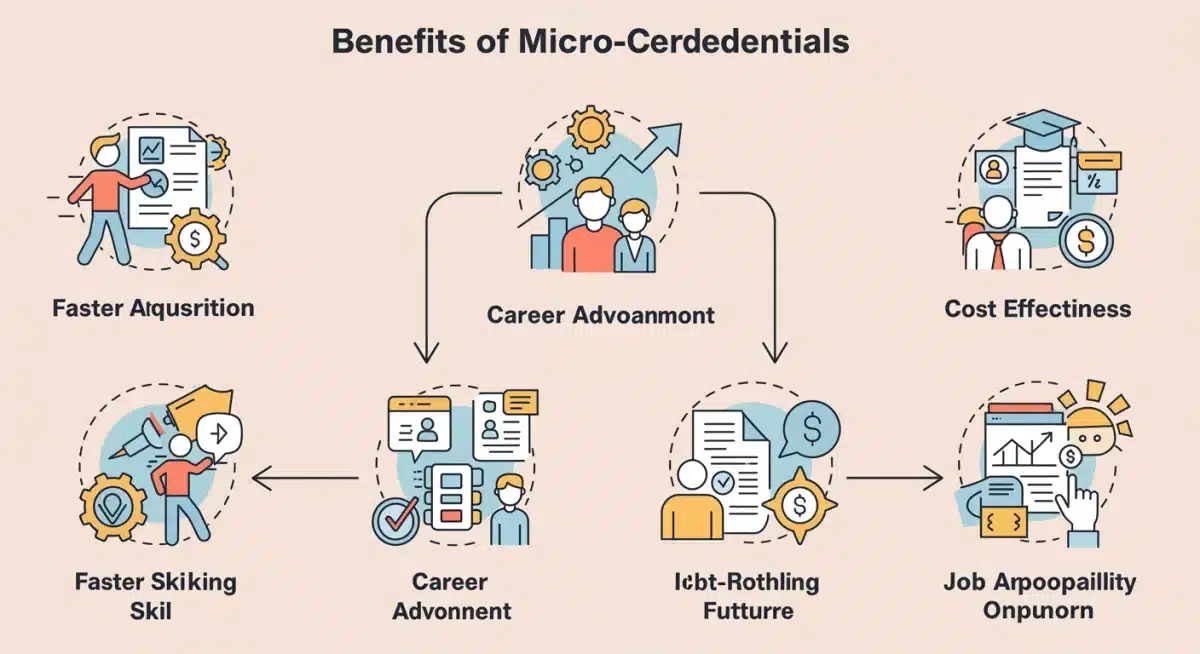
The convenience and accessibility of online micro-credential programs further amplify their impact, making skill development available to a broader demographic, including those in remote areas or with demanding schedules. This widespread access contributes to a more equitable and skilled workforce across the nation.
Benefits for individuals and employers
The widespread adoption of micro-credentials brings substantial benefits to both individuals seeking to advance their careers and employers striving to build a skilled workforce. For individuals, these credentials offer a clear, efficient path to enhance their marketability and earning potential. For employers, they provide a reliable mechanism for validating specific skills and addressing critical talent gaps.
Professionals can strategically choose micro-credentials that align with their career aspirations, filling specific skill gaps identified in their current roles or preparing them for future opportunities. This personalized approach to learning is far more efficient than traditional, broad-based education. Employers, in turn, can confidently invest in candidates or current employees who possess these verified competencies, knowing they can contribute immediately.
Empowering the workforce
Individuals gain a powerful tool for self-directed learning and professional growth. They can curate a portfolio of diverse skills, each validated by a recognized credential. This empowers them to take control of their career trajectory, making informed decisions about their learning investments. The transparency of micro-credentials also helps in showcasing their abilities to potential employers more effectively.
- Increased employability: Targeted skills make individuals more attractive to employers.
- Higher earning potential: Specialized skills often command better salaries.
- Personalized learning paths: Tailor education to specific career goals.
- Proof of competency: Verifiable demonstration of acquired skills.
Strategic talent development for businesses
For businesses, micro-credentials are a strategic asset in talent development and acquisition. They enable companies to reskill and upskill their existing workforce in a cost-effective and timely manner, reducing the need for external hiring. This internal talent development fosters employee loyalty and ensures that the organization possesses the necessary capabilities to innovate and compete.
Furthermore, micro-credentials simplify the hiring process by providing clear indicators of a candidate’s specific abilities. Employers can filter for applicants with particular credentials, streamlining recruitment and ensuring a better match between job requirements and candidate skills. This precision in hiring leads to improved productivity and reduced turnover, benefiting the company’s bottom line.
Challenges and considerations for widespread adoption
Despite their promising potential, the widespread adoption of micro-credentials in the U.S. faces several challenges and considerations that need to be addressed. These include issues related to standardization, recognition, funding, and quality assurance. Overcoming these hurdles will be crucial for micro-credentials to fully realize their transformative impact on professional development.
One of the primary concerns is the lack of a universal framework for quality assurance and recognition. With numerous providers offering micro-credentials, ensuring consistency in quality and ensuring that these credentials are broadly accepted by employers remains a significant task. Without clear standards, the value of some micro-credentials might be questioned, hindering their widespread acceptance.
Ensuring quality and recognition
Establishing robust quality assurance mechanisms is paramount. This involves developing clear standards for curriculum design, assessment methods, and learning outcomes. Collaboration between educational institutions, industry bodies, and government agencies will be essential to create a credible and widely recognized system for micro-credential validation.
- Standardization efforts: Developing common frameworks for quality.
- Employer acceptance: Encouraging broader recognition by hiring managers.
- Accreditation challenges: Integrating micro-credentials into existing accreditation systems.
- Funding models: Exploring sustainable funding for micro-credential programs.

Addressing these challenges will require concerted effort from all stakeholders. Governments may need to play a role in incentivizing the development of high-quality micro-credentials and promoting their use. Educational institutions will need to adapt their offerings, and employers will need to adjust their hiring practices to fully embrace this new credentialing paradigm.
The role of technology in micro-credentialing
Technology is not merely an enabler of micro-credentials; it is deeply embedded in their very fabric, driving their accessibility, verifiability, and scalability. Digital platforms, blockchain, and artificial intelligence are playing pivotal roles in shaping how micro-credentials are delivered, managed, and recognized, making them more efficient and trustworthy than ever before.
Online learning platforms have democratized access to micro-credential programs, allowing individuals to learn from anywhere at any time. This flexibility is critical for professionals balancing work and family commitments. The use of digital badges and blockchain technology for credential verification adds a layer of security and transparency that traditional paper certificates often lack, preventing fraud and ensuring authenticity.
Digital platforms and verifiable credentials
The rise of massive open online courses (MOOCs) and specialized learning platforms has provided a fertile ground for micro-credentials to flourish. These platforms offer structured learning experiences, often incorporating interactive elements, peer reviews, and automated assessments. This technological infrastructure supports the efficient delivery and evaluation of targeted skill acquisition.
- Blockchain for verification: Ensuring tamper-proof and verifiable credentials.
- AI-powered assessment: Personalized feedback and objective evaluation.
- Learning analytics: Tracking progress and identifying skill gaps effectively.
- Digital badging: Easily shareable and recognizable proof of achievement.
Blockchain technology, in particular, is poised to revolutionize how micro-credentials are issued and managed. By creating an immutable record of achievement, blockchain can significantly enhance the credibility and portability of these credentials, allowing individuals to carry their verified skills with them throughout their careers, regardless of the issuing institution.
Future outlook: Micro-credentials in 2026 and beyond
Looking ahead to 2026 and beyond, the trajectory for micro-credentials in U.S. professional development appears robust and expansive. They are set to become an indispensable component of lifelong learning, playing a crucial role in maintaining a dynamic and competitive workforce. The integration of micro-credentials into broader educational and employment ecosystems will continue to deepen, solidifying their status as a legitimate and valuable form of qualification.
We can anticipate a future where micro-credentials are not just supplementary but integral to career pathways, with more employers actively seeking and even requiring them for specific roles. Educational institutions will increasingly embed micro-credentials within their degree programs, offering modular learning options that cater to diverse student needs and industry demands. This convergence will blur the lines between traditional and alternative education.
Integration into academic and corporate structures
The coming years will likely see greater formalization of micro-credential pathways, with clearer articulation agreements between micro-credential providers and higher education institutions. This will allow individuals to seamlessly transfer their micro-credential learning towards associate’s or bachelor’s degrees, maximizing the value of their focused skill development.
Corporations will also play a larger role, not just as consumers of micro-credentials but as creators. Many companies are already developing their own internal micro-credential programs to train employees in proprietary technologies or specialized business processes. This trend is expected to grow, further integrating micro-credentials into corporate learning and development strategies.
Ultimately, the future of professional development in the U.S. will be characterized by a hybrid model, where traditional degrees are complemented and enhanced by a rich tapestry of micro-credentials. This adaptive framework will empower individuals to navigate an ever-changing job market with confidence and ensure that the U.S. workforce remains at the forefront of global innovation.
| Key Aspect | Brief Description |
|---|---|
| Skill-Centric Shift | Focus moves from broad degrees to specific, verifiable skills for career advancement. |
| Flexibility & Speed | Quick acquisition of in-demand skills, vital for rapidly changing industries. |
| Employer Benefits | Precise talent acquisition, efficient upskilling of existing workforce. |
| Technology Integration | Digital platforms, blockchain, and AI enhance delivery and verification. |
Frequently asked questions about micro-credentials
A micro-credential is a certification of a specific skill or competency, typically acquired through short, focused learning experiences. They are verifiable and demonstrate mastery in a particular area, unlike broader traditional degrees. They are designed for quick and targeted skill development.
Micro-credentials are much shorter, focusing on a single skill or small set of skills, while traditional degrees offer a comprehensive, multi-year curriculum. Micro-credentials prioritize immediate job market relevance and flexibility over extensive academic breadth.
Yes, recognition is growing significantly. Many U.S. employers are increasingly valuing micro-credentials as proof of specific, in-demand skills, especially in tech and specialized industries. This trend is expected to strengthen by 2026 as skill-based hiring becomes more prevalent.
Absolutely. By allowing professionals to quickly acquire and demonstrate new skills, micro-credentials can open doors to promotions, new roles, or even career changes. They enable continuous upskilling and reskilling, crucial for staying competitive in a dynamic job market.
Technology is central. Online platforms facilitate delivery, while digital badges and blockchain ensure secure, verifiable, and portable credentials. AI aids in personalized learning and assessment, making micro-credentials accessible and efficient for a global workforce.
Conclusion
The ascent of micro-credentials is undeniably reshaping U.S. professional development, positioning them as a vital force in the future of work by 2026. Their capacity to deliver targeted, verifiable skills quickly and flexibly addresses the urgent demands of a rapidly evolving economy. As individuals seek agile pathways for career growth and employers prioritize specific competencies, micro-credentials offer a compelling solution. While challenges in standardization and widespread recognition persist, the ongoing integration of technology and collaborative efforts across sectors are paving the way for these bite-sized qualifications to become an indispensable component of lifelong learning, fostering a more skilled, adaptable, and competitive American workforce.
