Updated FDIC Insurance Limits for 2026: Protecting Your Deposits Up to $250,000

The Federal Deposit Insurance Corporation (FDIC) continues to protect your hard-earned money, with updated insurance limits for 2026 ensuring deposits are secure up to $250,000 per depositor, per bank, per ownership category, providing essential financial stability.
Understanding the Updated FDIC Insurance Limits for 2026: Protecting Your Deposits Up To $250,000 is crucial for every American depositor. As we look ahead, knowing how your money is safeguarded provides peace of mind and empowers you to make informed financial decisions. This comprehensive guide will walk you through everything you need to know about these vital protections.
understanding the FDIC: your financial safety net
The Federal Deposit Insurance Corporation (FDIC) is an independent agency of the United States government that protects depositors of insured banks and savings associations against the loss of their deposits if an FDIC-insured bank fails. Established in 1933, in response to the widespread bank failures during the Great Depression, the FDIC has been a cornerstone of American financial stability ever since. Its primary mission is to maintain public confidence in the U.S. financial system.
When you deposit money into an FDIC-insured bank, you are automatically covered. There is no need to apply for FDIC insurance, and it comes at no cost to you, the depositor. This automatic protection is a fundamental aspect of the American banking system, designed to prevent bank runs and ensure that ordinary citizens do not lose their life savings due to unforeseen economic events or poor bank management.
The FDIC’s role extends beyond simply insuring deposits; it also examines and supervises financial institutions for safety and soundness, manages receiverships for failed banks, and promotes consumer protection. This multi-faceted approach helps to maintain a stable and secure banking environment for all. It’s important to recognize that while the FDIC provides a critical safety net, it does not insure investments in stocks, bonds, mutual funds, life insurance policies, annuities, or municipal securities, even if these investments are purchased at an insured bank.
In essence, the FDIC serves as a vital guardian of your deposits, offering a foundational layer of security that underpins the trust and confidence essential for a functioning economy. Its continued presence and evolving regulations ensure that financial protections remain robust and relevant for modern depositors.
what are the updated FDIC insurance limits for 2026?
For 2026, the standard insurance amount remains firmly set at $250,000 per depositor, per insured bank, for each ownership category. This limit has been a constant source of security for millions of Americans, providing a clear ceiling on the amount of money the FDIC will guarantee in the event of a bank failure. It’s not just a number; it’s a promise to protect your savings and ensure financial stability.
This $250,000 limit applies to various types of deposit accounts, including checking accounts, savings accounts, money market deposit accounts, and certificates of deposit (CDs). The consistency of this limit across different account types means that regardless of how you structure your basic savings, the same level of federal protection applies. Understanding this standard is the first step toward effectively managing your insured funds.
understanding the ‘per depositor, per bank, per ownership category’ rule
The phrase ‘per depositor, per insured bank, per ownership category’ is key to maximizing your FDIC coverage. It means that if you have accounts in different ownership categories at the same bank, or accounts at different FDIC-insured banks, you could be insured for more than $250,000. This is a common point of confusion, but it’s a powerful tool for savvy savers.
- Per Depositor: Each individual’s deposits are insured separately.
- Per Insured Bank: Deposits at different banks are insured separately.
- Per Ownership Category: Different types of account ownership provide separate insurance coverage.
For example, if you have a single account and a joint account at the same bank, both could be fully insured up to $250,000, effectively doubling your coverage at that institution. This nuanced understanding allows depositors to strategically structure their finances to ensure greater protection for their assets. The FDIC provides online tools and resources to help you calculate your exact coverage, making it easier to navigate these rules.
maximizing your FDIC coverage: smart strategies
To fully leverage the protections offered by the Updated FDIC Insurance Limits for 2026: Protecting Your Deposits Up To $250,000, it’s essential to understand how to structure your accounts strategically. Simply having more than $250,000 in a single account at one bank won’t increase your coverage. However, by utilizing different ownership categories, you can significantly expand your insured funds.
One common strategy involves opening accounts in different ownership categories. For instance, a single individual account is insured up to $250,000. If that same individual also has a joint account with another person, the joint account is separately insured up to $500,000 (each co-owner’s share up to $250,000). This immediately provides a combined $750,000 in coverage at a single institution, assuming the accounts meet the criteria for separate ownership categories.
exploring different ownership categories
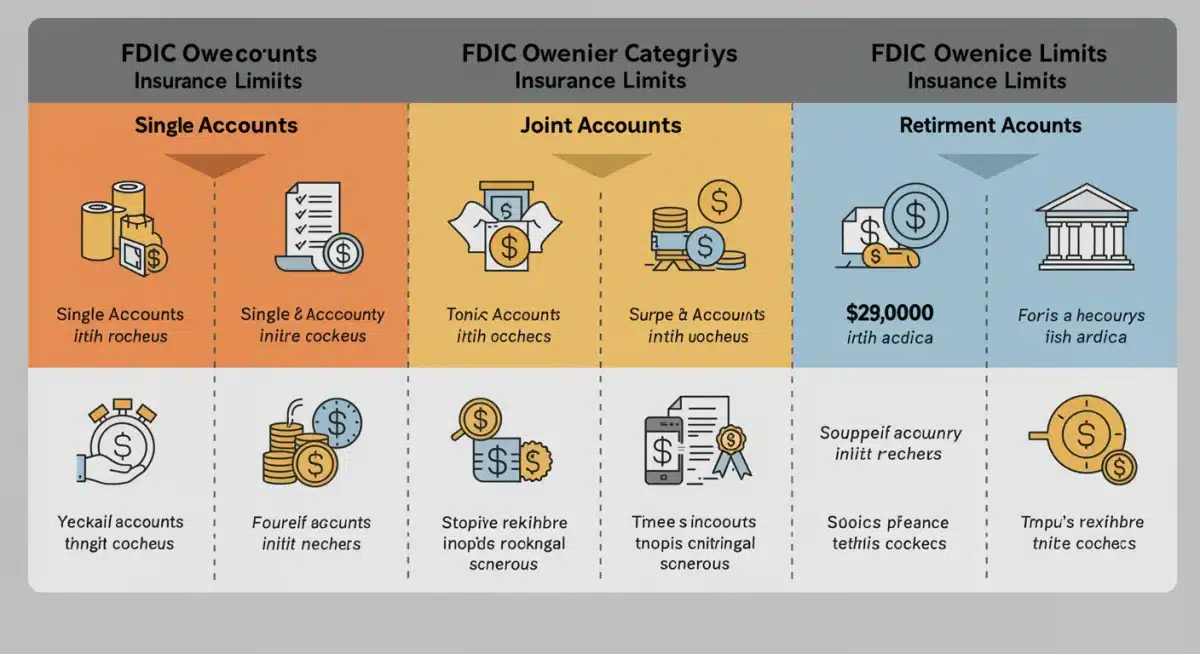
The FDIC recognizes several distinct ownership categories, each providing its own $250,000 insurance limit. These include: single accounts, joint accounts, certain retirement accounts (like IRAs and self-directed Keogh accounts), revocable trust accounts, irrevocable trust accounts, corporation/partnership/unincorporated association accounts, and government accounts. Each category is treated independently for insurance purposes, allowing for substantial aggregate coverage.
- Single Accounts: Owned by one individual, insured up to $250,000.
- Joint Accounts: Owned by two or more people, insured up to $250,000 per co-owner.
- Retirement Accounts: IRAs, 401(k)s, and other self-directed retirement plans are separately insured up to $250,000 per participant.
- Trust Accounts: Can offer significant coverage depending on the number of beneficiaries and the structure of the trust.
For those with substantial savings, spreading funds across multiple FDIC-insured banks is another effective strategy. Since the $250,000 limit applies per bank, having $250,000 at Bank A and another $250,000 at Bank B means you have $500,000 fully insured. This simple diversification can be a powerful way to ensure all your funds are protected without complex account structures.
Furthermore, for businesses and organizations, understanding the specific rules for corporate, partnership, and government accounts is crucial. These entities also benefit from the $250,000 limit per ownership category, allowing them to protect significant operational funds. Consulting with a financial advisor or directly with the FDIC can help clarify how these rules apply to unique financial situations, ensuring optimal protection for all deposits.
the importance of FDIC insurance in 2026’s economic landscape
In an ever-evolving economic landscape, the stability offered by the Updated FDIC Insurance Limits for 2026: Protecting Your Deposits Up To $250,000 remains as critical as ever. While the financial system has become more robust since the days of the Great Depression, unforeseen events can still create uncertainty. The FDIC acts as a crucial buffer, preventing localized bank failures from snowballing into broader financial crises and protecting the individual depositor from immediate loss.
The confidence that FDIC insurance instills in the banking system is invaluable. Without it, depositors might rush to withdraw their money at the first sign of trouble, potentially causing otherwise solvent banks to fail. This phenomenon, known as a bank run, can destabilize entire economies. The FDIC’s guarantee ensures that depositors have no reason to panic, allowing the financial system to absorb shocks more effectively and maintain operational continuity.
Moreover, in a world where digital banking and online financial services are increasingly prevalent, the underlying security provided by the FDIC is paramount. While the convenience of digital transactions is undeniable, the fundamental need for deposit protection does not change. Whether your money is held in a traditional brick-and-mortar bank or a purely online institution, if it’s FDIC-insured, the same $250,000 limit applies, offering consistent security across platforms.
The year 2026, like any other, will present its own set of economic challenges and opportunities. From market fluctuations to geopolitical events, various factors can influence financial stability. Having robust deposit insurance mechanisms in place ensures that individual savers and businesses can continue to operate with confidence, knowing their essential funds are secure. This unwavering commitment to deposit protection is a cornerstone of a healthy and resilient economy.
what the FDIC does not insure
While the Updated FDIC Insurance Limits for 2026: Protecting Your Deposits Up To $250,000 offer significant protection for your deposits, it’s equally important to understand what the FDIC does not cover. A common misconception is that all financial products offered by an insured bank are automatically protected. This is not the case, and misunderstanding this distinction can lead to unexpected losses.
The FDIC specifically insures deposit accounts. This means checking accounts, savings accounts, money market deposit accounts, and certificates of deposit (CDs) are covered. However, many other financial products, even those sold by an FDIC-insured bank, are not deposits and therefore not insured. These typically include investment products that carry inherent market risk.
uninsured financial products
- Stocks, Bonds, and Mutual Funds: These investment products fluctuate in value with market conditions and are not covered by FDIC insurance.
- Annuities: While often sold by banks, annuities are insurance products and fall outside the scope of deposit insurance.
- Life Insurance Policies: Similar to annuities, life insurance is an insurance product and not a deposit.
- Safe Deposit Box Contents: The contents of a safe deposit box are not deposits; they are not insured by the FDIC.
- U.S. Treasury Bills, Notes, or Bonds: Although backed by the full faith and credit of the U.S. government, these are not deposits and are not FDIC-insured.
It is crucial for depositors to differentiate between insured deposits and uninsured investment products. Banks are required to clearly disclose which products are and are not FDIC-insured. Always ask for clarification if you are unsure about the coverage of a particular financial product. Understanding these limitations is a vital part of comprehensive financial planning, ensuring you make informed decisions about where and how to keep your money.
The distinction between insured and uninsured products highlights the importance of due diligence. While the FDIC is an excellent safeguard for your cash deposits, it’s not a blanket guarantee for all financial assets held at a bank. Investors must assess the risks associated with non-deposit products independently and consider other forms of insurance or diversification strategies for those assets.
how to check if your bank is FDIC-insured
Ensuring your bank is FDIC-insured is a straightforward but crucial step in protecting your deposits under the Updated FDIC Insurance Limits for 2026: Protecting Your Deposits Up To $250,000. Fortunately, the FDIC makes it very easy for consumers to verify the insurance status of any financial institution. This simple check can provide immense peace of mind and confirm that your money is indeed protected.
The most reliable way to check is by using the FDIC’s official BankFind tool. This online resource allows you to search for any bank by name, location, or certificate number. The tool will quickly confirm whether the institution is FDIC-insured and provide details about its status. It’s a free and accessible service designed specifically for public verification.
other verification methods
Beyond the online tool, there are other indicators and methods to confirm FDIC insurance:
- Look for the FDIC Sign: All FDIC-insured institutions are required to display an official FDIC sign at their teller windows or on their premises. This sign is a clear visual confirmation of their insured status.
- Check Bank Statements and Websites: Most banks prominently feature their FDIC insurance status on their official websites, account statements, and marketing materials. Look for phrases like ‘Member FDIC’ or the FDIC logo.
- Ask a Bank Representative: If you are still unsure, do not hesitate to ask a bank employee directly. They should be able to confirm their institution’s FDIC insurance status.
It’s important to be vigilant, especially with newer online-only financial platforms or lesser-known institutions. While most legitimate banks are FDIC-insured, a quick verification can prevent potential issues. Never assume a bank is insured; always confirm it. This small effort ensures that your deposits are safeguarded by the federal government’s guarantee, aligning with the protections offered by the latest limits.

common myths and misconceptions about FDIC insurance
Despite its long-standing presence and clear guidelines, the Updated FDIC Insurance Limits for 2026: Protecting Your Deposits Up To $250,000 are still subject to several common myths and misconceptions. Dispelling these can help depositors better understand their protections and avoid unnecessary anxiety or missteps in financial planning.
One prevalent myth is that the FDIC only insures traditional checking and savings accounts. As discussed, this is incorrect; money market deposit accounts and certificates of deposit are also fully covered. The key is that they must be deposit products, not investment products. Another misconception is that if a bank fails, it takes a long time to get your money back. In reality, the FDIC typically pays out insured deposits within a few business days, often by providing deposits in a new bank or issuing checks directly.
addressing key misconceptions
- Myth: The FDIC insures all products sold at a bank.
- Reality: Only deposit accounts are insured; investments like stocks, bonds, and mutual funds are not.
- Myth: You need to apply for FDIC insurance.
- Reality: Coverage is automatic for all deposit accounts at insured banks.
- Myth: The $250,000 limit is per account.
- Reality: The limit is per depositor, per bank, per ownership category, allowing for greater overall coverage.
- Myth: If a bank fails, your money is lost forever.
- Reality: Insured deposits are quickly returned to depositors, often within days.
Another common misunderstanding revolves around the safety of online banks. Many people incorrectly believe that online-only banks are less secure or not FDIC-insured. This is false. As long as an online bank is chartered and operates under U.S. banking laws, it can be, and usually is, FDIC-insured just like a traditional brick-and-mortar institution. The method of banking (online vs. physical branch) does not affect FDIC coverage.
Finally, some believe that the FDIC fund is limited and might run out during a widespread crisis. The FDIC maintains a substantial Deposit Insurance Fund (DIF), which is backed by the full faith and credit of the U.S. government. This means that even if the DIF were to be depleted, the U.S. government stands behind the FDIC’s obligations, ensuring that insured deposits will always be protected. Understanding these realities reinforces the robust nature of FDIC protection and its enduring reliability.
| Key Aspect | Description |
|---|---|
| Insurance Limit | $250,000 per depositor, per bank, per ownership category. |
| Covered Accounts | Checking, savings, money market deposit accounts, CDs. |
| Uninsured Products | Stocks, bonds, mutual funds, annuities, safe deposit box contents. |
| Verification | Use FDIC’s BankFind tool or look for ‘Member FDIC’ signs. |
Frequently Asked Questions about FDIC Insurance
‘Per ownership category’ means that different types of accounts, such as single accounts, joint accounts, or retirement accounts, are insured separately up to the $250,000 limit, even if they are at the same bank. This allows individuals to have more than $250,000 insured at one institution.
No, you do not need to apply for FDIC insurance. If your bank is an FDIC-insured institution, your deposit accounts are automatically covered up to the specified limits. This protection is a standard feature of banking with an insured institution and comes at no cost to you.
No, only deposit products like checking accounts, savings accounts, money market deposit accounts, and certificates of deposit are FDIC-insured. Investment products such as stocks, bonds, mutual funds, and annuities are not covered, even if purchased through an FDIC-insured bank.
If an FDIC-insured bank fails, the FDIC typically pays out insured deposits within a few business days. This is often achieved by transferring accounts to a healthy bank or by issuing checks directly to depositors. The goal is a rapid and seamless return of funds.
Yes, you can have more than $250,000 insured. This is possible by holding funds in different ownership categories at the same bank, or by spreading your deposits across multiple FDIC-insured banks. Each combination provides separate coverage up to the $250,000 limit.
conclusion
The Updated FDIC Insurance Limits for 2026: Protecting Your Deposits Up To $250,000 continue to stand as a bedrock of financial security for American depositors. These protections are not merely a regulatory detail but a fundamental guarantee that supports confidence in our banking system. By understanding the standard $250,000 limit, leveraging different ownership categories, and verifying your bank’s insured status, you can ensure your hard-earned money is safeguarded against unforeseen circumstances. The FDIC’s unwavering commitment to protecting deposits allows individuals and businesses alike to plan for the future with greater certainty, reinforcing the stability and resilience of the U.S. financial landscape. Staying informed and proactive about these limits is crucial for every depositor seeking peace of mind in their financial journey.
