AI’s Impact on K-12 Curriculum in 2026: What You Need to Know
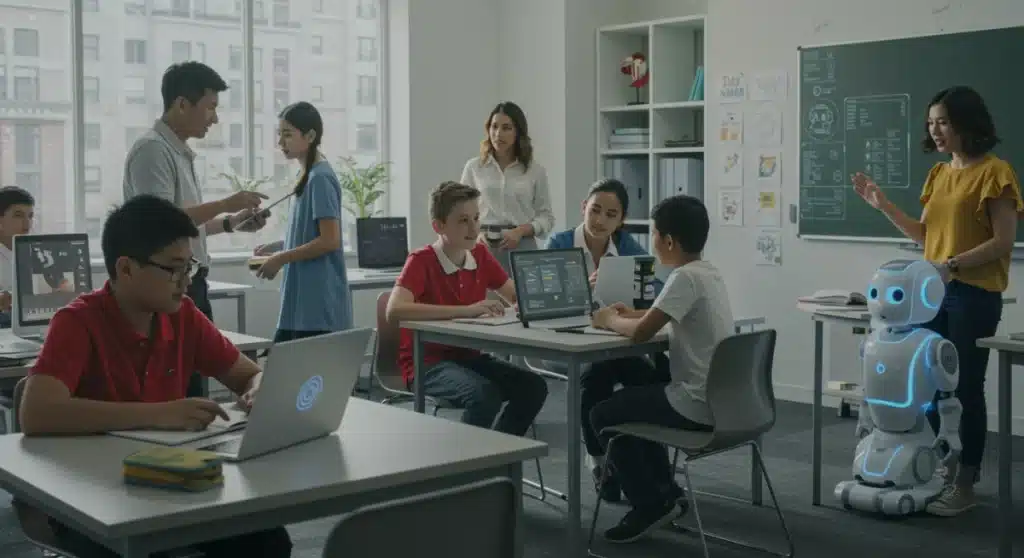
By 2026, artificial intelligence will profoundly reshape K-12 education, influencing curriculum design, teaching methodologies, and student learning experiences across the United States.
The landscape of education is constantly evolving, and by 2026, the influence of artificial intelligence will be undeniable. Understanding the impact of AI on K-12 curriculum in 2026: what parents and educators need to know now is crucial for preparing students for a future where AI is deeply integrated into daily life and work. This article delves into how AI is set to transform K-12 learning, offering insights for all stakeholders.
The rise of AI in K-12 education
Artificial intelligence is no longer a futuristic concept confined to science fiction; it is rapidly becoming an integral part of our present, and its presence in K-12 education is expanding at an unprecedented rate. By 2026, AI tools will move beyond experimental phases to become commonplace in classrooms, influencing everything from administrative tasks to the very core of instructional delivery.
This integration is driven by the potential of AI to address long-standing challenges in education, such as personalized learning, efficient assessment, and equitable access to resources. Educators are increasingly recognizing that AI can augment their capabilities, allowing them to focus more on higher-order teaching and student engagement, rather than routine tasks.
AI-powered administrative efficiencies
AI’s role in streamlining administrative processes is often overlooked but incredibly significant. Teachers and school administrators spend countless hours on tasks that could be automated, freeing up valuable time for direct student interaction and curriculum development.
- Automated grading for objective assessments.
- Intelligent scheduling and resource allocation.
- Predictive analytics for student attendance and performance.
- Personalized communication tools for parent-teacher interactions.
These efficiencies translate into more time for educators to innovate and connect with students on a deeper level. The shift is not about replacing human roles but about enhancing them, making the educational system more responsive and less burdened by manual processes.
The broader adoption of AI in education also reflects a societal trend. As AI becomes more pervasive in industries and daily life, it is imperative that educational institutions prepare students to understand, utilize, and critically evaluate AI technologies. This preparation begins in K-12, laying the foundational knowledge and skills necessary for future success.
Transforming curriculum design and delivery
The core of K-12 education – the curriculum itself – is undergoing a profound transformation due to AI. Traditional, one-size-fits-all curricula are giving way to more dynamic, adaptive models that cater to individual student needs and learning styles. AI’s ability to analyze vast amounts of data on student performance and preferences enables the creation of highly personalized learning paths.
By 2026, we expect to see curriculum frameworks that are not only informed by AI but are also designed to teach students about AI itself. This includes developing AI literacy, understanding ethical implications, and fostering critical thinking about AI-generated content.
Personalized learning experiences
One of the most significant impacts of AI is its capacity to deliver truly personalized learning. AI algorithms can identify a student’s strengths, weaknesses, and preferred learning modalities, then adapt content and pacing accordingly. This means that students who grasp concepts quickly can move ahead, while those needing more support receive targeted interventions.
- Adaptive learning platforms that adjust difficulty in real-time.
- AI tutors providing immediate feedback and explanations.
- Content recommendations tailored to individual student interests.
- Gamified learning experiences driven by AI to enhance engagement.
This level of personalization was once an aspirational goal, but AI is making it a reality. It ensures that every student has the opportunity to learn at their optimal pace, maximizing their potential and fostering a deeper understanding of subjects.
Furthermore, AI can help educators identify learning gaps and patterns that might otherwise go unnoticed. By providing data-driven insights, AI empowers teachers to make more informed instructional decisions, creating a more effective and equitable learning environment for all students.
AI’s role in assessment and feedback
Assessment is a critical component of education, and AI is revolutionizing how we evaluate student learning and provide feedback. Gone are the days when assessments were solely summative, occurring only at the end of a unit or semester. AI enables continuous, formative assessment, offering real-time insights into student comprehension and progress.
This shift allows for timely interventions and adjustments to teaching strategies, ensuring that students receive support precisely when they need it. By 2026, AI-powered assessment tools will be sophisticated enough to evaluate not just factual recall but also higher-order thinking skills, creativity, and problem-solving abilities.
Intelligent assessment systems
AI-driven assessment systems go beyond simple multiple-choice grading. They can analyze open-ended responses, essays, and even project-based work, providing nuanced feedback that helps students understand where they went wrong and how to improve.
- Automated essay scoring with constructive feedback.
- Adaptive quizzes that adjust questions based on performance.
- Performance analytics dashboards for teachers and students.
- Identification of common misconceptions across a class.
The immediate and detailed feedback provided by AI is invaluable for student learning. It allows students to correct errors and deepen their understanding without waiting for a teacher to manually review their work. This iterative process of learning and feedback accelerates skill development.

Moreover, AI can help reduce the burden of grading for teachers, allowing them to dedicate more time to designing engaging lessons and providing individualized support. The efficiency gained through AI in assessment contributes to a more balanced and effective educational ecosystem.
Challenges and ethical considerations
While the promise of AI in K-12 education is immense, its implementation is not without challenges and ethical considerations. As with any powerful technology, careful planning and thoughtful policies are essential to ensure that AI serves to enhance education equitably and responsibly. Issues such as data privacy, algorithmic bias, and the digital divide require serious attention.
By 2026, schools and districts will need robust frameworks in place to navigate these complexities, ensuring that AI tools are used to benefit all students without inadvertently creating new disparities or compromising student well-being.
Addressing data privacy and security
The collection and analysis of student data by AI systems raise significant privacy concerns. Schools must ensure that student information is protected from breaches and used only for educational purposes, with transparent policies that parents can understand.
- Strict data encryption and anonymization protocols.
- Clear consent processes for data collection.
- Regular audits of AI systems for security vulnerabilities.
- Educating students, parents, and staff on data privacy best practices.
Building trust in AI educational tools hinges on robust data privacy and security measures. Parents need assurance that their children’s data is safe and not being exploited for commercial purposes or other non-educational uses.
Another critical concern is algorithmic bias. If AI systems are trained on biased data, they can perpetuate or even amplify existing inequalities, particularly for students from marginalized groups. Developers and educators must work together to ensure that AI algorithms are fair, transparent, and equitable in their application.
Preparing educators for an AI-driven future
The successful integration of AI into K-12 curriculum hinges on the preparedness of educators. Teachers are not merely users of AI tools; they are crucial facilitators who must understand how to leverage AI effectively to enhance learning outcomes. This requires significant investment in professional development and ongoing training.
By 2026, teacher training programs and professional learning opportunities must evolve to equip educators with the necessary skills to navigate an AI-rich classroom environment, moving beyond basic digital literacy to AI literacy and pedagogical innovation.
Essential professional development for teachers
Educators need more than just technical training; they require a deep understanding of how AI can be integrated into their pedagogical practices. This includes learning to use AI for personalized instruction, assessment, and even curriculum development.
- Workshops on AI-powered learning platforms.
- Training in interpreting AI-generated student data.
- Discussions on ethical AI use in the classroom.
- Opportunities to collaborate on AI-driven lesson plans.
Ongoing professional development is vital to keep pace with the rapid advancements in AI technology. Teachers must feel confident and competent in their ability to utilize AI as a powerful tool, rather than viewing it as a threat or an overwhelming complexity.

Furthermore, school leaders play a critical role in fostering a culture of innovation and support for AI integration. Providing resources, time for experimentation, and opportunities for peer learning will be essential for successful adoption.
The evolving role of parents and community
As AI reshapes K-12 education, the role of parents and the broader community also evolves. Parents will need to understand how AI is being used in their children’s schools, advocate for responsible implementation, and support their children in developing AI literacy skills. Community engagement will be crucial in ensuring that AI integration aligns with local values and educational goals.
By 2026, open communication channels between schools, parents, and the community will be more important than ever to navigate the changes brought by AI and ensure that all stakeholders are informed and involved in shaping the future of education.
Parental engagement in AI education
Parents are key partners in their children’s education, and their understanding of AI’s impact is paramount. Schools should proactively engage parents, providing clear information about the AI tools being used, their benefits, and the measures taken to ensure student privacy and safety.
- Informational sessions and workshops for parents on AI in education.
- Accessible resources explaining AI concepts and applications.
- Opportunities for parents to provide feedback on AI initiatives.
- Guidance on fostering AI literacy at home.
Empowering parents with knowledge about AI will enable them to better support their children’s learning and engage constructively with schools. This partnership ensures a holistic approach to preparing students for an AI-driven world.
Community involvement, including local businesses and technology experts, can also provide valuable insights and resources for schools. Collaborations can lead to real-world learning opportunities for students and help bridge the gap between classroom learning and future career demands in an AI-powered economy.
Future skills for an AI-powered world
The integration of AI into K-12 curriculum by 2026 is not just about teaching with AI, but also about teaching for an AI-powered world. This means focusing on developing skills that complement AI capabilities, rather than being replaced by them. Critical thinking, creativity, problem-solving, and emotional intelligence will become even more vital.
Curricula will need to emphasize these human-centric skills, alongside foundational knowledge in AI and data science, to equip students with the adaptability and resilience needed to thrive in a rapidly changing global landscape.
Cultivating human-centric skills
While AI can handle routine and analytical tasks, skills unique to human cognition and interaction will be at a premium. Education must pivot to nurture these abilities, preparing students for roles that require complex judgment, empathy, and innovation.
- Project-based learning emphasizing collaborative problem-solving.
- Curriculum units focused on ethical reasoning and digital citizenship.
- Opportunities for creative expression and design thinking.
- Activities fostering social-emotional learning and communication.
These skills are not only crucial for future careers but also for navigating personal and civic life in an increasingly complex and interconnected world. AI will augment human intelligence, making the development of these distinctively human capabilities even more important.
Furthermore, understanding the principles of AI, even at a basic level, will be a fundamental literacy. Students will need to be able to interact with AI systems intelligently, understand their limitations, and critically evaluate the information they provide. This dual focus – on human skills and AI literacy – will define effective K-12 education in the coming years.
| Key Aspect | Description of AI’s Impact by 2026 |
|---|---|
| Curriculum Personalization | AI will enable highly individualized learning paths, adapting content and pace to each student’s needs. |
| Assessment & Feedback | Continuous, formative AI assessments will provide real-time, constructive feedback to students and teachers. |
| Educator Roles | Teachers will become facilitators of AI-enhanced learning, requiring new skills and ongoing professional development. |
| Ethical Considerations | Data privacy, algorithmic bias, and digital equity will be crucial ethical challenges to address. |
Frequently asked questions about AI in K-12 education
AI will analyze your child’s learning patterns, strengths, and weaknesses to tailor educational content and pace. This means adaptive exercises, AI tutors offering targeted help, and individualized learning pathways, ensuring education is uniquely suited to their needs and helping them excel at their own speed.
AI will foster critical thinking, creativity, problem-solving, and digital literacy. While AI handles routine tasks, students will focus on human-centric skills like ethical reasoning and emotional intelligence. They will also gain foundational knowledge of how AI works, preparing them for future careers and responsible interaction with technology.
Ensuring data privacy and security is a top priority. Schools are implementing strict encryption, anonymization, and clear consent policies. Parents should inquire about specific data protection measures, usage policies, and how schools safeguard student information from breaches, ensuring transparency and trust in AI systems.
Teachers will undergo extensive professional development to become skilled facilitators of AI-enhanced learning. They will learn to leverage AI for personalized instruction, interpret data, and focus on higher-order teaching. Their role will shift from sole knowledge providers to guides, mentors, and innovators in an AI-rich classroom environment.
Key ethical concerns include data privacy, potential algorithmic bias, and ensuring equitable access. There’s a risk that AI could perpetuate existing inequalities if not carefully implemented. Schools must establish robust frameworks to ensure AI tools are fair, transparent, and benefit all students without compromising their well-being or creating new disparities.
Conclusion
The integration of AI into K-12 curriculum by 2026 represents a pivotal moment in education. It promises to revolutionize learning through personalization, enhanced assessment, and administrative efficiencies, ultimately preparing students for an AI-powered future. While challenges related to data privacy, algorithmic bias, and teacher preparedness exist, proactive engagement from parents, educators, and the community can ensure that AI serves as a powerful force for positive change in American schools. Embracing AI thoughtfully and strategically will be key to unlocking its full potential to create more engaging, equitable, and effective learning experiences for every student.
