Future of Online Learning: 5 Trends Shaping U.S. Higher Ed 2026

The future of online learning in U.S. higher education by 2026 will be defined by five key trends: hyper-personalization, AI integration, micro-credentialing, immersive technologies, and globalized access, fundamentally transforming how students learn and engage.
The landscape of education is constantly evolving, and nowhere is this more apparent than in the realm of digital instruction. By 2026, the future of online learning in U.S. higher education will be dramatically different, shaped by a confluence of technological advancements and changing student demands. This article delves into the five most impactful trends poised to redefine how American colleges and universities deliver education.
Hyper-Personalization: Tailoring the Learning Journey
The days of one-size-fits-all education are rapidly fading. Hyper-personalization in online learning signifies a profound shift towards educational experiences meticulously crafted to suit individual student needs, preferences, and learning styles. This trend moves beyond simple adaptive learning, aiming for a truly bespoke educational journey for every learner.
As technology advances, educators gain unprecedented capabilities to analyze student data, identifying strengths, weaknesses, and preferred learning modalities. This allows for dynamic adjustments to curriculum delivery, assessment methods, and even the pace of instruction. The goal is to maximize engagement and optimize learning outcomes by making education feel uniquely designed for each student, fostering a deeper connection with the material and a greater sense of ownership over their academic progress.
Adaptive Learning Paths
Adaptive learning platforms are at the forefront of hyper-personalization. These systems utilize sophisticated algorithms to assess a student’s current knowledge and adjust the content and difficulty level in real-time. This ensures that students are always challenged appropriately, preventing boredom from overly simple tasks and frustration from overly difficult ones.
- Individualized content delivery based on pre-assessment results.
- Dynamic adjustment of learning pace according to student mastery.
- Personalized feedback mechanisms that pinpoint specific areas for improvement.
- Curated resources and supplementary materials tailored to individual needs.
Student-Centric Support Systems
Beyond content, hyper-personalization extends to the support systems available to students. This includes personalized academic advising, mental health resources, and career guidance that are proactively offered based on student profiles and behaviors. The aim is to create a holistic support network that anticipates and addresses student challenges before they escalate, ensuring a more seamless and successful educational experience.
The integration of AI-powered chatbots and virtual assistants also plays a crucial role here, providing instant answers to common questions and directing students to the most relevant resources, further enhancing the personalized support ecosystem. This proactive approach to student well-being and academic success is a cornerstone of the future of online learning.
In essence, hyper-personalization transforms online education from a broadcast model to a highly interactive and responsive dialogue between the learner and the learning environment. This shift promises to unlock greater student potential and foster a more engaging and effective educational experience, fundamentally changing how U.S. higher education operates by 2026.
AI Integration: Intelligent Tutors and Automated Assessments
Artificial Intelligence (AI) is no longer a futuristic concept; it is rapidly becoming an integral part of higher education, especially within online learning environments. By 2026, AI integration will revolutionize teaching and learning by providing intelligent tutoring systems and automating various assessment processes, freeing up educators to focus on more complex pedagogical tasks.
AI’s ability to process vast amounts of data and identify patterns makes it an invaluable tool for enhancing educational delivery. From providing instantaneous feedback to personalizing learning materials, AI is set to make online education more efficient, effective, and responsive to student needs. This technological leap will allow for a scale of personalized interaction previously unimaginable in traditional educational settings.
AI-Powered Tutoring Systems
Intelligent tutoring systems powered by AI can offer students personalized, on-demand support. These systems can answer questions, explain complex concepts, and guide students through problem-solving exercises. They learn from student interactions, continually refining their approach to provide the most effective assistance possible. This means students can receive help precisely when and where they need it, overcoming common barriers in online learning.
- Real-time feedback on assignments and exercises.
- Personalized explanations of difficult topics.
- Adaptive practice problems that adjust to student performance.
- Identification of learning gaps and recommendation of targeted resources.
Automated and Smart Assessments
The automation of assessments through AI will significantly reduce the grading burden on instructors, allowing them to dedicate more time to teaching and student engagement. AI can grade essays, code, and even provide nuanced feedback on complex projects. Beyond simple grading, AI can also analyze assessment data to identify trends in student understanding, providing valuable insights for curriculum improvement.
Furthermore, AI-powered proctoring tools are enhancing academic integrity in online environments. These tools can monitor student behavior during exams, flagging suspicious activities and ensuring a fair assessment process. This not only maintains the credibility of online degrees but also builds trust in the digital learning ecosystem.

The strategic integration of AI into online learning platforms will foster a more interactive, supportive, and academically rigorous environment. This trend is not about replacing human educators but empowering them with tools to deliver a superior educational experience, marking a significant milestone in the future of online learning in the U.S. higher education landscape.
Micro-Credentialing and Skill-Based Learning: The Modular Future
The traditional four-year degree is increasingly being complemented, and in some cases challenged, by the rise of micro-credentialing and skill-based learning. By 2026, U.S. higher education will see an accelerated adoption of modular, stackable credentials that focus on specific, in-demand skills, offering greater flexibility and immediate career relevance for learners.
This shift is driven by the rapidly changing job market, which demands continuous upskilling and reskilling. Students and professionals alike are seeking more agile ways to acquire new competencies without committing to lengthy and expensive degree programs. Micro-credentials, such as digital badges or certificates, provide verifiable proof of mastery in a particular skill, making them highly attractive to both learners and employers.
Flexible Learning Pathways
Micro-credentials enable highly flexible learning pathways. Students can accumulate credentials over time, building a portfolio of skills that directly align with their career goals. This modular approach allows individuals to learn at their own pace, often while working, and to target specific knowledge gaps. It democratizes access to specialized training, making higher education more accessible and responsive to individual circumstances.
- Stackable credentials that can lead to larger qualifications.
- Short, focused courses designed to teach specific skills.
- Recognition of prior learning and experience.
- Increased employability through targeted skill acquisition.
Industry Alignment and Employability
A key advantage of micro-credentialing is its strong alignment with industry needs. Educational institutions are increasingly collaborating with employers to design programs that teach the exact skills companies are looking for. This direct link between learning and employment outcomes ensures that graduates are job-ready and possess the competencies required in today’s dynamic workforce.
This trend also empowers individuals to showcase their abilities in a granular way, moving beyond a generic degree to demonstrate concrete skills. For employers, micro-credentials offer a transparent and efficient way to assess candidates’ qualifications, leading to better hiring decisions. The emphasis on tangible skills will redefine how educational value is perceived and delivered in the future of online learning.
The move towards micro-credentialing signifies a fundamental re-evaluation of how higher education prepares individuals for their careers. It champions a future where learning is continuous, adaptable, and directly tied to professional development, ensuring that U.S. higher education remains relevant and valuable in an ever-changing world.
Immersive Technologies: VR and AR in the Virtual Classroom
The integration of immersive technologies, specifically Virtual Reality (VR) and Augmented Reality (AR), is poised to transform the virtual classroom experience in U.S. higher education by 2026. These technologies promise to create highly engaging, interactive, and experiential learning environments that transcend the limitations of traditional online instruction.
VR and AR offer unparalleled opportunities for students to explore complex concepts, practice hands-on skills, and collaborate in ways that were previously impossible in a remote setting. By simulating real-world scenarios and enabling interactive visualizations, these technologies are set to make online learning more dynamic, memorable, and effective, bridging the gap between theoretical knowledge and practical application.
Virtual Labs and Field Trips
VR can transport students to virtual laboratories where they can conduct experiments, manipulate scientific models, and analyze data without the need for physical equipment. This is particularly beneficial for disciplines like science, engineering, and medicine, where hands-on experience is crucial but often limited by resources or accessibility. Similarly, virtual field trips can take students to historical sites, distant ecosystems, or even inside the human body, offering rich contextual learning experiences.
- Simulated environments for risk-free experimentation.
- Access to rare or expensive equipment in a virtual setting.
- Immersive historical and cultural explorations.
- Collaborative virtual spaces for group projects and discussions.
Augmented Reality for Enhanced Learning
AR overlays digital information onto the real world, enhancing textbooks, anatomical models, or even machinery with interactive 3D content. This allows students to visualize complex structures, understand intricate processes, and interact with digital objects in their physical surroundings. For instance, medical students could use AR to view organs in 3D during a lecture, or engineering students could examine a virtual engine superimposed on a physical workspace.
The ability of AR to blend digital and physical realities creates a powerful new dimension for learning, making abstract concepts tangible and fostering deeper understanding. These tools are not just novelties; they are becoming essential components for delivering a truly cutting-edge educational experience in the future of online learning.
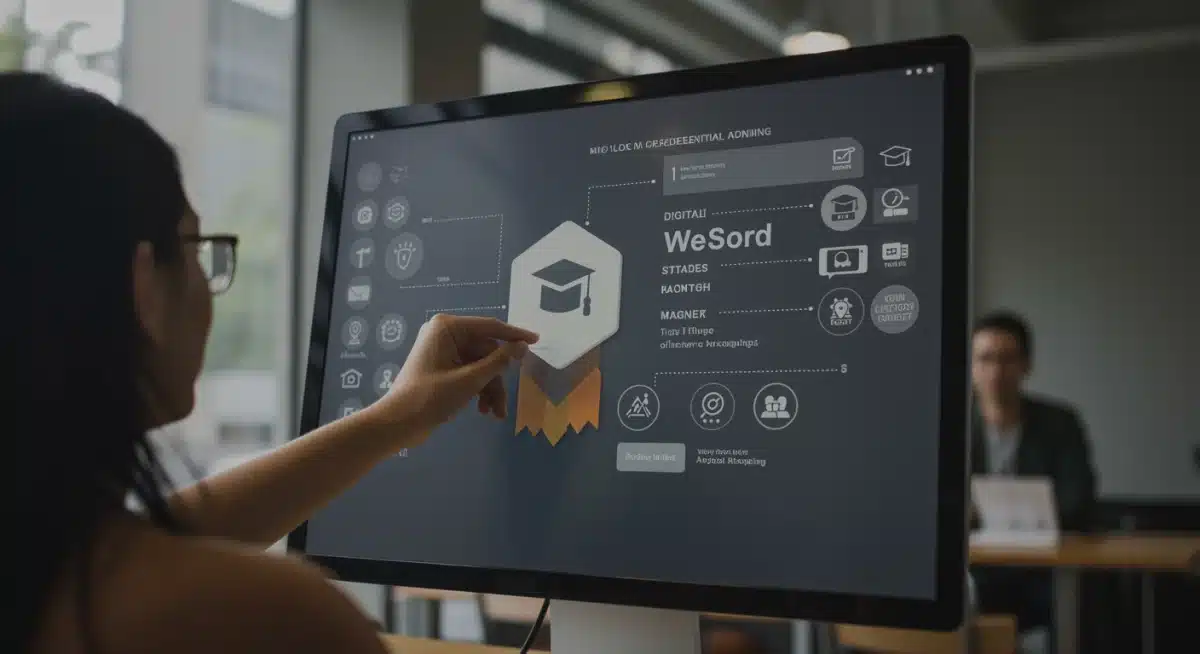
The widespread adoption of VR and AR will significantly elevate the quality and impact of online education, offering immersive learning experiences that were once the exclusive domain of physical classrooms. This technological wave promises to make online learning more engaging, practical, and ultimately, more effective for students across all disciplines.
Globalized Access and Collaborative Learning Networks
The internet has always facilitated global connections, but by 2026, the future of online learning will be characterized by a truly globalized access to education and the proliferation of collaborative learning networks that transcend geographical boundaries. U.S. higher education institutions will increasingly attract and educate students from around the world, fostering diverse learning environments and promoting international collaboration.
This trend is driven by several factors, including the increasing demand for high-quality education, the flexibility of online formats, and the desire for diverse perspectives in learning. Online platforms remove the traditional barriers of relocation and visa requirements, making world-class education accessible to a much broader audience, regardless of their physical location.
Borderless Education Initiatives
Universities are actively developing borderless education initiatives, forming partnerships with international institutions and offering programs specifically designed for a global student body. This includes courses delivered in multiple languages, culturally sensitive curricula, and support services tailored to international students. The goal is to create a seamless and inclusive educational experience for learners worldwide.
- Joint degree programs with international universities.
- Online courses accessible from any country.
- Virtual exchange programs for cultural immersion.
- Support services for diverse student populations.
Enhanced Global Collaboration
The rise of collaborative learning networks means students from different countries can work together on projects, share insights, and learn from each other’s unique perspectives. This not only enriches the learning experience but also prepares students for a globally interconnected workforce where cross-cultural communication and collaboration are essential skills. Tools for virtual collaboration, such as shared digital workspaces and real-time communication platforms, will become even more sophisticated.
These networks foster a sense of global community within the online learning environment, allowing students to develop a broader understanding of global issues and different cultural contexts. This exposure is invaluable in today’s world, equipping graduates with the global fluency needed to thrive in their professional and personal lives. The expansion of global access and collaborative networks is a defining characteristic of the future of online learning.
Ultimately, the globalization of online learning will transform U.S. higher education into a truly international enterprise, enriching the educational experience for all participants and preparing a new generation of globally aware and competent professionals.
Lifelong Learning and Upskilling Ecosystems
The concept of education as a finite period in one’s life is being rapidly replaced by the paradigm of lifelong learning. By 2026, U.S. higher education will be deeply embedded within comprehensive lifelong learning and upskilling ecosystems, catering to individuals at every stage of their professional journeys. This trend is a direct response to the accelerating pace of technological change and the continuous need for workforce adaptation.
As industries evolve, the skills required for success change just as quickly. Universities are recognizing their role in providing continuous educational opportunities, not just for traditional students, but for working professionals seeking to update their skills, pivot careers, or simply pursue personal intellectual growth. Online learning is the ideal modality for delivering this continuous education, offering unparalleled flexibility and accessibility.
Continuous Professional Development
Higher education institutions are developing extensive portfolios of professional development courses, certifications, and executive education programs. These offerings are designed to be short, focused, and directly applicable to current industry demands. They allow professionals to acquire new skills or deepen existing ones without interrupting their careers, ensuring they remain competitive in a dynamic job market.
- Short courses and bootcamps for rapid skill acquisition.
- Industry-recognized certifications for specialized fields.
- Executive education programs for leadership development.
- Partnerships with corporations for customized training solutions.
Integrated Learning Platforms
The future will see integrated learning platforms that track an individual’s educational journey from initial degree programs through various upskilling modules and professional development courses. These platforms will serve as comprehensive digital portfolios, showcasing a learner’s full range of competencies and achievements. This holistic approach to learning supports career progression and personal growth over an entire lifetime.
Furthermore, these ecosystems will incorporate career counseling and job placement services that are continuously updated with market trends, helping learners navigate their professional paths. The emphasis will be on creating a seamless transition between learning and earning, ensuring that education remains a relevant and valuable investment throughout a person’s life. This long-term engagement is a hallmark of the evolving future of online learning.
The transformation of U.S. higher education into a lifelong learning ecosystem underscores its commitment to societal relevance and individual empowerment. By embracing continuous education, universities will solidify their position as indispensable partners in personal and professional development for decades to come.
| Key Trend | Brief Description |
|---|---|
| Hyper-Personalization | Tailored learning experiences based on individual student needs and styles. |
| AI Integration | Intelligent tutoring systems and automated, smart assessments. |
| Micro-Credentialing | Modular, skill-based certifications offering flexibility and career relevance. |
| Immersive Technologies | VR/AR creating engaging, experiential learning in virtual classrooms. |
Frequently Asked Questions About the Future of Online Learning
Hyper-personalization is expected to significantly boost student engagement by tailoring content, pace, and support to individual needs. This bespoke approach makes learning more relevant and enjoyable, reducing attrition rates and fostering a deeper connection with educational material, ultimately leading to improved academic outcomes and satisfaction.
By 2026, AI will be crucial in automating and enhancing online assessments. It will provide instant, detailed feedback on assignments, help grade complex projects, and identify learning gaps. AI-powered proctoring will also ensure academic integrity, making assessments more efficient, fair, and insightful for both students and educators.
While micro-credentials offer flexible, skill-specific alternatives, they are more likely to complement rather than fully replace traditional degrees by 2026. They serve as valuable additions for upskilling and reskilling, enhancing employability and allowing for continuous professional development, often stacking towards broader qualifications alongside or after a degree.
VR and AR will make online learning more effective by creating immersive, experiential environments. VR allows for realistic simulations and virtual field trips, while AR overlays digital information onto the real world. These technologies provide hands-on practice, visual understanding of complex concepts, and deeper engagement, enhancing memory and practical application of knowledge.
Globalized access means U.S. online students will interact with a more diverse international peer group and have access to global resources and perspectives. This fosters cross-cultural understanding and prepares them for a globalized workforce. It also implies that U.S. institutions will attract a wider international student body, enriching the overall educational ecosystem.
Conclusion
The journey towards 2026 promises a revolutionary transformation in U.S. higher education’s online learning landscape. The five trends discussed—hyper-personalization, AI integration, micro-credentialing, immersive technologies, and globalized access—collectively point towards a future where education is more adaptable, engaging, and relevant than ever before. These developments are not mere technological novelties; they represent fundamental shifts in pedagogical approach and institutional strategy, designed to meet the evolving needs of students and the demands of a dynamic global workforce. By embracing these trends, U.S. higher education will continue to solidify its position as a leader in innovation, ensuring that learning remains a powerful catalyst for individual growth and societal progress.
